It arrived today: Camino Calm; the Diary...A Pilgrim's Tale. My friend Jaqui Tutt went on-line to a self-publishing house and published her diary in book form.
It is exquisite!
I love it!
There is something about pilgrimage, and for Jaqui this pilgrimage, that brings about a new sense of calm, while for veteran pilgrims it restores a calmness in life long gone. Pilgrimage, even with all its trials and tribulations, is restorative. I find the balance of life restored after I've been on pilgrimage.
But then again, the real work of the pilgrimage takes place upon our return home.
Pace, B
Friday, January 15, 2010

Thursday, January 14, 2010

Tuesday, January 12, 2010
Prayers for a Planetary Pilgrim

Saw this poem in the Church of Reconciliation (Chapel Hill, NC) newsletter by Edward Hays and his "A Psalm of New Wine Skins":
"Come, O you who are ever-new,
wrap my heart in new skin,
ever flexible to be reformed by your Spirit.
Set my feet ot fresh paths this day:
inspire me to speak original and life giving words
and to creatively give shape to the new.
Come and teach me how to dance with delight
Whenever your send a new melody my way."
Pace!
B
Thursday, January 7, 2010
Epiphany, Eastern Orthodox Church Style

On widipedia.com, I found this nugget of info on Epiphany in the Eastern Orthodox Church:
The observance had its origins in the Eastern Christian Churches, and was a general celebration of the Incarnation of Jesus Christ. It included the commemoration of: his birth; the visit of the Magi ("Wise Men", as Magi were Persian priests) to Bethlehem; all of Jesus' childhood events, up to and including his baptism in the Jordan by John the Baptist; and even the miracle at the Wedding of Cana in Galilee.[3]
It seems that baptism is big in the understanding of Epiphany. The photo above is one I took of people being baptized in the Jordan.What connects Epiphany with pilgrimage is this: for the Church, Jesus baptism is truly his first step toward crucifixion; it is the first step of his earthly pilgrimage, God's pilgrimage, among us.
Pace!
B
Wednesday, January 6, 2010
Epiphany!

The photo above is where the manger was supposedly located.
The area in which one bows the head and kisses the place of the Christ-child's manger is nearby.
It is a cramped spot.
It is tight.
It is holy.
Something happened there, here, in the world, that changed the axis of the world.
Wise men, the Magi, "Three Kings," however you want to call them, the ultimate Outsiders, got the gist of what was happening: a new day was and has dawned. A new day in which we now live between heaven and earth, with glimpses of earth all over the place.
Pace!
Happy Epiphany!
B
Monday, January 4, 2010
Moving From Labyrinth to Pilgrimage
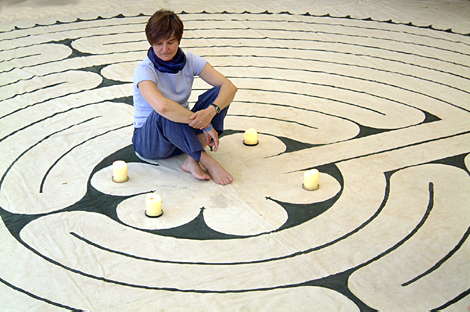
There was a nice article on a labyrinth at Millbrook Baptist Church in Raleigh, and how intrinsic it has become to the community of faith, and others who are interested in this peculiar spiritual practice.
From the News and Observer and Yonat Shimron:
A journey made easier
In ancient times, the labyrinth was used as a substitute for a pilgrimage to Jerusalem.
When political upheavals made travel to the Middle East dangerous, the Roman Catholic Church created seven "pilgrimage" cathedrals where people used the labyrinth to make spiritual instead of physical journeys. France's Chartres Cathedral, 50 miles southwest of Paris, is the only one where a labyrinth remains.
Millbrook Baptist's labyrinth is modeled on the Chartres pattern, which was built in 1174.
Judy Homer, a Raleigh spiritual director who has been leading workshops on labyrinths for 15 years, said she hopes Millbrook's example will serve as a prototype for other churches.
"If enough people are working toward peace, it raises the vibration level," she said.
To her, the labyrinth is a path of illumination that can transform and change people's brain chemistry. Unlike a maze, a labyrinth has no tricks or dead ends. A single path winds from the outside of the circle to its center, shaped like a flower.
The path has three parts: walking into the center, resting in the heart of the labyrinth, and walking out.
"It's the soul's need to draw within, to circle into center," Homer said.
The beauty of the labyrinth is that there are no formulas or rituals to learn. People walk at their own pace and meditate on their own thoughts.
That's one reason Jones thinks it might be a tool for peacemaking. People of faith as well as people without faith can participate.
"There's something about the space that offers people a sanctuary for solitary meditation," Jones said. "It builds on itself and seems to have a contagious effect."
Click here for more.
My hope? That people will walk from labyrinth to pilgrimage. My other hope? To be able to convince people of this move!
Pace!
Buen Camino!
BSunday, January 3, 2010
The Magi Pilgrimage
Closing in on Epiphany: celebration of the Magi coming to visit the Christ child.
It is all about pilgrimage!
Pace!
B
It is all about pilgrimage!
Pace!
B
Subscribe to:
Posts (Atom)